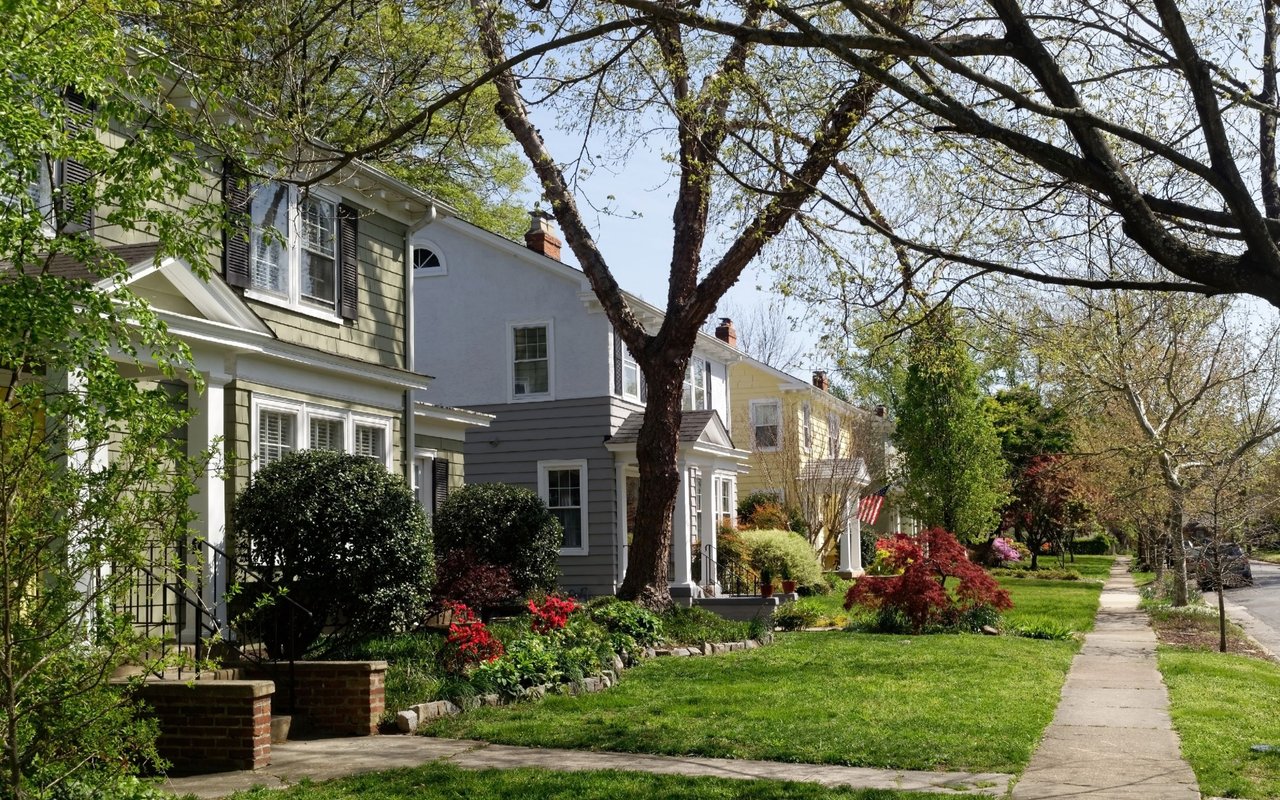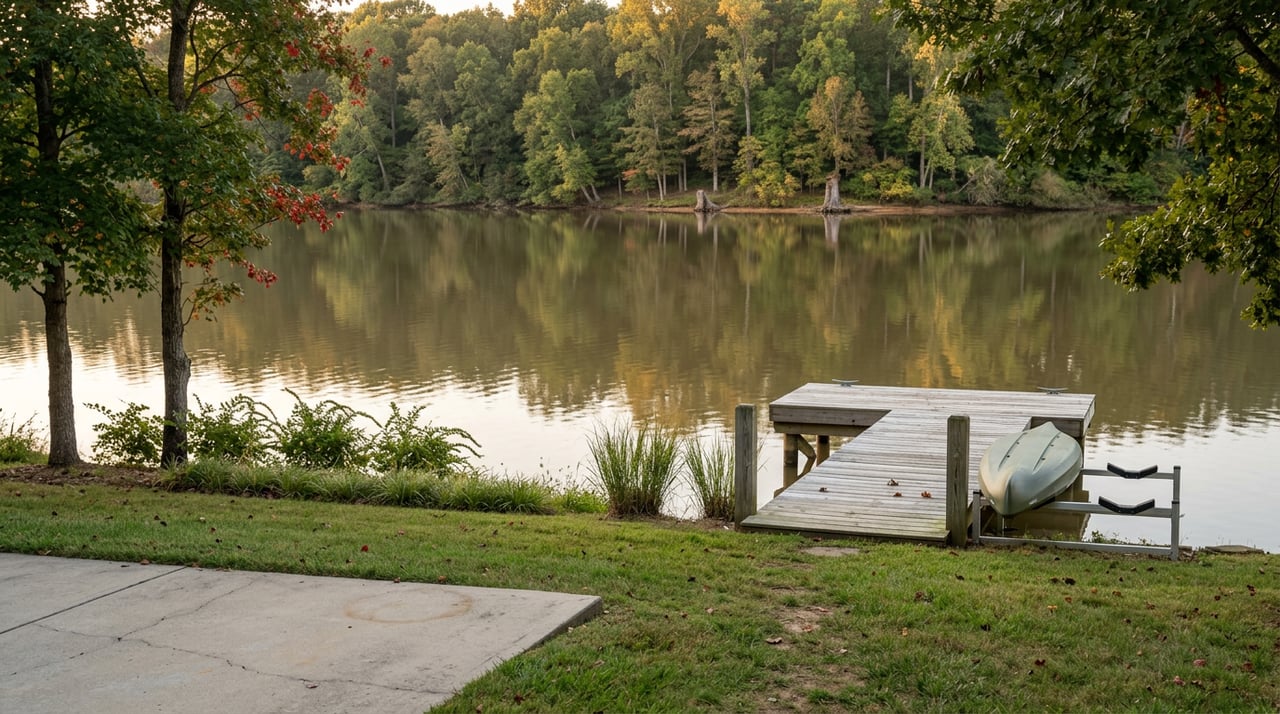
Ask someone outside Midlothian what lake living looks like on Swift Creek Reservoir and they'll picture something that doesn't exist here. Kids cannonballing off a dock. A ski boat cutting a wake at sunset. None of that happens on this reservoir, and if you've spent even one season inside Brandermill or Woodlake, you already know why. Swift Creek Reservoir supplies roughly a fifth of Chesterfield County's drinking water, which is the reason gasoline and diesel motors are banned outright and swimming isn't permitted anywhere along its 1,700 acres. The lake that anchors both communities is, by design, mostly hands off.
That restriction is the part outsiders never account for, and it's also the reason the two HOAs sitting on the same body of water have built two almost opposite versions of what "living near the lake" means day to day.
Why You Can Paddle But Can't Swim
The reservoir was built in 1965 by damming Swift Creek to secure water for a growing suburban population, and it still does that job first. Chesterfield County's own water quality reports describe the reservoir's recreational use plainly: electric and non-powered boating and fishing, with contact recreation such as swimming not permitted, since the reservoir's primary purpose is potable water supply. Crappie, bluegill, yellow perch, channel catfish, and chain pickerel fill out the fish population across the reservoir's coves and shallow arms.
The one part of reservoir management most residents never hear about is hydrilla. Chesterfield County's own fisheries reports track the invasive plant closely, and the finding is counterintuitive: water quality data show the reservoir actually performs better with a moderate amount of hydrilla present than with none at all, since a bare lake bottom does worse for fish habitat and, indirectly, for the water quality the county is trying to protect. The county stocks grass carp to keep the plant in check rather than eliminate it, which is a strange kind of ecological math for a lake most residents will never touch.
So if the water itself is mostly a backdrop, the real differences between Brandermill and Woodlake show up in what each HOA built around it.
Brandermill Bet On Access
Brandermill is the older of the two communities, laid out in the 1970s across roughly 3,000 acres and now home to about 3,792 homes, condos, and townhomes spread over 80 distinct neighborhoods and close to 14,000 residents. The HOA's spending priorities lean toward getting residents onto the water in whatever limited way the county allows. Assessments fund a full-service dock facility near Harbour Pointe, boat rental spaces, multiple boat launch points, and 15 miles of paved trails that residents use for everything from morning runs to the evening bike loop past Sunday Park. A marina slip runs $1,500 a year, water and electric included.
That access comes with its own paperwork rhythm that regulars know by heart. Every watercraft used on the reservoir, whether it's a kayak stored under a deck or a jon boat tied off at a waterfront dock, has to be registered annually with the Brandermill Community Association, and that includes paddle boards and inflatables. Renewal runs on a January cycle, with stickers required to be displayed by early February or a per-item late fee kicks in. Waterfront homeowners get to keep one motorized and one non-motorized boat secured at the water's edge behind their property, and everyone else works the waitlist for storage racks at spots like Waterside Park. It's a small piece of local bureaucracy, but it's the kind of detail that only shows up if you've actually registered a boat here.
Ask around and you'll hear residents mention Commodore Point as the spot for sunset paddles, the place where herons and osprey work the shoreline while kayakers wait for golden hour. It isn't marked on any tourist map. It's just where people go, which is its own kind of local knowledge.
All of this runs on a 2026 residential assessment of $925 a year, billed quarterly at $231.25 and due the first of January, April, July, and October.
Woodlake Bet On Programming
Woodlake came later, developed through the 1980s and into the 1990s on roughly 2,100 acres adjacent to Brandermill, with about 2,700 homes and close to 8,000 residents. Where Brandermill spends on water access, Woodlake's amenity list reads like a recreation center that happens to have a lake view: 13 miles of trails, 16 playgrounds, three outdoor pools and one indoor pool, 16 tennis courts, six pickleball courts, and a fitness center running more than 70 classes a week. The community's covered lakeside pavilion, built with picnic tables, a barbecue and fireplace setup, lighting, and a stage, functions as the social hub for the kind of programmed gathering Woodlake leans into.
The clearest evidence of that programming instinct shows up twice a month in the form of Woodlake's Maker's Markets, split between an evening version running 4 to 7 p.m. at 5000 Woodlake Village Parkway and a separate daytime market at a second location. Vendors bring their own tents and tables, the community provides the address and the crowd, and it's become one of the more reliable weekend fixtures for residents who want something to do without leaving the neighborhood.
Neither approach is objectively better. Brandermill suits residents who measure a good weekend by trail miles and time on the water in whatever form the county allows. Woodlake suits residents who want their exercise scheduled and their Saturday morning market already on the calendar. The interesting part is that both communities are working around the exact same restriction, and they've spent three and four decades building deliberately different answers to it.
The One Night Both Sides Show Up For
If there's a single event that cuts across the Brandermill-Woodlake divide, it's the Chesterfield Concert Band's annual show at Sunday Park Pavilion, scheduled this year for September 14 from 6 to 7 p.m. The band is entirely volunteer run, more than 60 members ranging in age from 21 to 87, many of them playing together for 25 years or more. Residents bring chairs and blankets and settle in along the lakeside pavilion for an evening of live music that has nothing to do with boating rules or trail mileage and everything to do with the fact that this is still a small enough community that a decades-old volunteer band can fill a park on a Monday night in September.
Before The Weather Turns
A few practical notes worth keeping straight as summer gives way to fall around the reservoir:
- Watercraft registration with the Brandermill Community Association renews annually each January, and late fees apply per item after the deadline, so it's worth confirming your sticker status before spring rather than after.
- Storage waitlists for spots like the Waterside Park t-racks move periodically. If you've been meaning to get a kayak or paddle board off your deck, it's worth checking in with the BCA office rather than assuming there's no room.
- Woodlake's Maker's Markets run on a recurring schedule at two separate addresses, so it's worth confirming which location is hosting before you head out.
- Fishing continues on the reservoir through the fall, and cooler water once the heat breaks tends to make for better time on the water than the height of summer.
The Takeaway
The two communities look interchangeable from a distance: same lake, same HOA structure, same Midlothian zip codes. Spend a season inside either one and the difference becomes obvious. Brandermill decided that if the water itself is mostly off limits, the compensation is trail miles, marina slips, and quiet points along the shoreline. Woodlake decided the compensation is pickleball courts, fitness classes, and a market every couple of weeks. Both are working within the same county rule that keeps the actual water at arm's length. How each one chose to fill that gap says more about the character of the neighborhood than any brochure ever will.
For residents deciding which side of that gap fits their own weekend better, or for anyone comparing the two communities from the outside, The Lemus Group knows this stretch of Chesterfield block by block, in English and in Spanish. Start your Richmond home search with bilingual support available whenever you're ready to talk specifics.